Abstracts PortAudio using a given audio sample data type. More...
#include <audio_output.h>
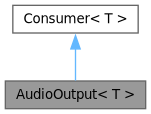
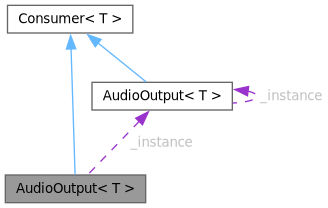
Static Public Member Functions | |
| static AudioOutput * | instance () |
| Factory method to return the AudioOutput. It may be called one or more times. Be sure to destroy() the instance in order to avoid leaks. It is suggested to do so in the teardown of the first caller. | |
| static void | init () |
| Initializes PortAudio. | |
| static void | destroy () |
| Tears down PortAudio. | |
| static void | restart () |
| Restarts PortAudio. | |
| static void | start () |
| Starts the invokation of the PortAudio callback. | |
| static void | stop () |
| Stops the invokation of the PortAudio callback. | |
| static bool | isDefault () |
| Returns whether the default audio output device is used. This indicates that a Bluetooth device is not being used. The default output is typically an audio jack or an HDMI port on the host. | |
Static Public Attributes | |
| static constexpr int | SAMPLE_RATE = 44100 |
| The AudioOutput sample rate, which is matched to the sample rate of CD audio. | |
Static Private Member Functions | |
| static int | pa_callback (const void *input_buffer, void *output_buffer, unsigned long frames_per_buffer, const PaStreamCallbackTimeInfo *time_info, PaStreamCallbackFlags status_flags, void *user_data) |
| The PortAudio callback. | |
Static Private Attributes | |
| static AudioOutput * | _instance |
| The global AudioOutput instance. | |
| static PaError | _pa_error |
| The most recent PortAudio error. | |
| static PaStream * | _pa_stream |
| The PortAudio stream. | |
Additional Inherited Members | |
 Public Member Functions inherited from Consumer< T > Public Member Functions inherited from Consumer< T > | |
| Consumer () | |
| Consumer constructor. | |
| virtual | ~Consumer () |
| Consumer destructor. | |
| virtual void | producer (Producer< T > *const producer) |
| Sets the producer from which to retrieve data. | |
| Protected Member Functions inherited from Consumer< T > | |
| T | consume () const |
| Returns one datum from the producer. | |
Detailed Description
class AudioOutput< T >
Abstracts PortAudio using a given audio sample data type.
- See also
- Producer/Consumer.
- Template Parameters
-
T The audio sample format. Must be int16_t or float.
Definition at line 20 of file audio_output.h.
Member Function Documentation
◆ destroy()
|
static |
Tears down PortAudio.
Definition at line 129 of file audio_output.h.
◆ init()
|
static |
Initializes PortAudio.
Definition at line 93 of file audio_output.h.
◆ instance()
|
static |
Factory method to return the AudioOutput. It may be called one or more times. Be sure to destroy() the instance in order to avoid leaks. It is suggested to do so in the teardown of the first caller.
- Returns
- The AudioOutput.
Definition at line 84 of file audio_output.h.
◆ isDefault()
|
static |
Returns whether the default audio output device is used. This indicates that a Bluetooth device is not being used. The default output is typically an audio jack or an HDMI port on the host.
- Returns
- Whether the default audio output device is used.
Definition at line 181 of file audio_output.h.
◆ pa_callback()
|
staticprivate |
The PortAudio callback.
- See also
- PortAudio documentation.
- Parameters
-
[in] input_buffer Not used. Normally used for audio recording. [in] output_buffer Pointer to a buffer of audio samples to be filled. Sent to the audio device upon the method's return. [in] frames_per_buffer The number of frames (left + right sample) in the output_buffer. [in] time_info Not used. [in] status_flags Not used. [in] user_data Not used.
- Returns
- 0 for the successful filling of the output_buffer.
Definition at line 186 of file audio_output.h.
◆ restart()
|
static |
Restarts PortAudio.
Definition at line 164 of file audio_output.h.
◆ start()
|
static |
Starts the invokation of the PortAudio callback.
Definition at line 146 of file audio_output.h.
◆ stop()
|
static |
Stops the invokation of the PortAudio callback.
Definition at line 155 of file audio_output.h.
Member Data Documentation
◆ _instance
|
staticprivate |
The global AudioOutput instance.
Definition at line 48 of file audio_output.h.
◆ _pa_error
|
staticprivate |
The most recent PortAudio error.
Definition at line 50 of file audio_output.h.
◆ _pa_stream
|
staticprivate |
The PortAudio stream.
Definition at line 51 of file audio_output.h.
◆ SAMPLE_RATE
|
staticconstexpr |
The AudioOutput sample rate, which is matched to the sample rate of CD audio.
Definition at line 45 of file audio_output.h.
The documentation for this class was generated from the following file:
- src/header_only/audio_output.h